History
Subject Leader: Miss I Aspinall
‘United in love and the light of Jesus, we inspire one another to learn, grow and shine.’
Our Vision
At our school, we believe that History helps children understand the world they live in—how it has changed, who has shaped it, and how the past continues to influence our lives today. Through exciting topics, rich stories, and hands‑on exploration, children learn to ask thoughtful questions, investigate evidence, and think like real historians.
Our History curriculum is carefully planned from Nursery to Year 6 so that children build knowledge step by step, revisit important ideas, and make meaningful connections across different time periods and cultures.
What We Aim to Achieve
We want every child to:
- Develop a strong sense of chronology—understanding when and why events happened.
- Learn about local, British, and world history in a way that is engaging, memorable, and meaningful.
- Use the key disciplinary skills historians rely on, such as identifying significance, cause and consequence, similarities and differences, and analysing sources.
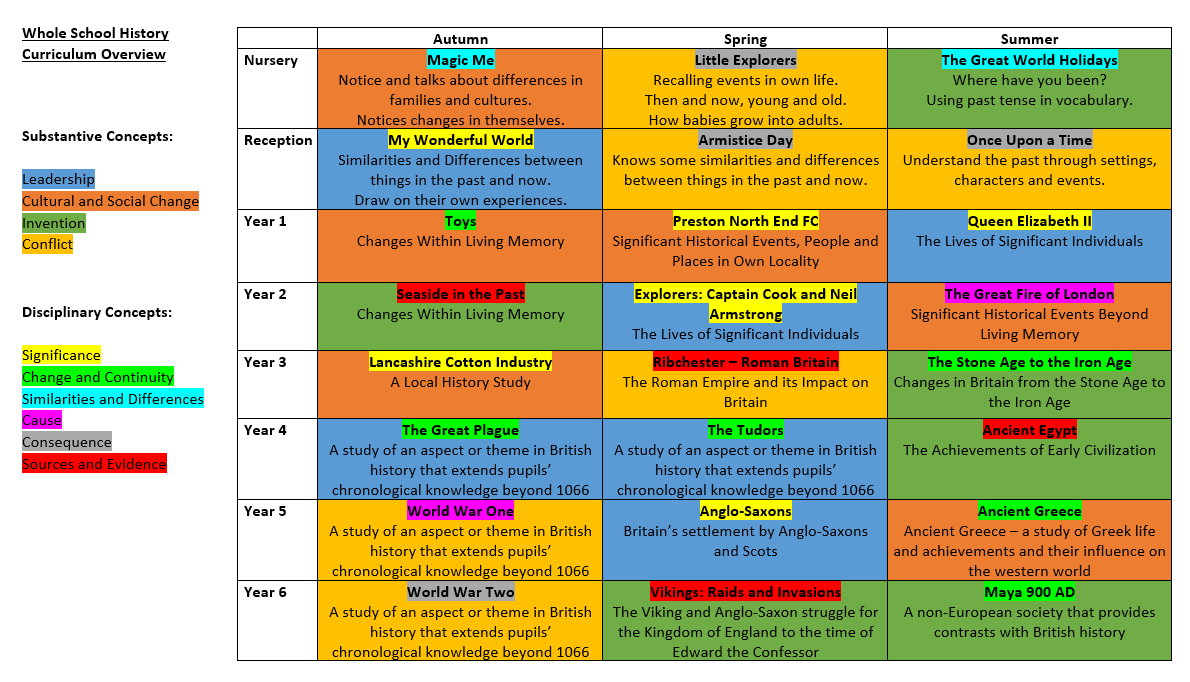
- Build historical understanding through four big ideas that run through our whole curriculum: Leadership, Cultural & Social Change, Invention, and Conflict.
- Appreciate diversity and understand how people from different times and places lived.
- Communicate clearly using accurate historical vocabulary.
- Become curious learners who enjoy exploring the past and making sense of the present.
How We Teach History
A Carefully Sequenced Curriculum
Our History curriculum runs from the Early Years up to Year 6. Topics are chosen to:
- Build knowledge in a logical order
- Strengthen children’s understanding of time
- Introduce and revisit important themes such as leadership, invention, and societal change
Each topic has a clear focus, a “big enquiry question”, and a planned outcome, so pupils know what they are working towards.
Enquiry‑Led Learning
Every History unit begins with a question such as:
- How significant was the Lancashire Cotton Industry, locally and internationally?
Children explore this question through a series of lessons where they investigate sources, examine evidence, ask questions, discuss ideas, and build their understanding step by step.
Developing Historical Skills
We build the skills of historical thinking as children move through school:
- Early Years: talking about the past, noticing changes, and exploring stories and objects
- Key Stage 1: sequencing simple events, exploring significant people and events, learning from photographs and artefacts
- Lower Key Stage 2: analysing evidence, explaining change, comparing cultures and civilisations
- Upper Key Stage 2: evaluating sources, forming arguments, explaining complex causes and consequences, and comparing societies in depth
Using Sources
Children regularly handle and examine:
- Artefacts
- Photographs
- Documents
- Oral histories
- Maps
- Museum resources
- Digital archives
Teachers model how historians question evidence: Who created this? When? Why? How do we know?
Vocabulary Matters
Historical vocabulary is explicitly taught and displayed in classrooms. Children learn and revisit key words linked to each topic, helping them speak and write with accuracy and confidence.
Our Local Area
We make the most of our rich local heritage. Children learn about:
- Preston North End FC
- The Lancashire Cotton Industry
- Roman Ribchester
- Local museums and historic sites
Trips, theme days, visitors, and hands-on experiences help bring the past to life.
Inclusion for All Children
Every child is supported to access the History curriculum. Teachers use:
- Visual aids and timelines
- Pre‑teaching of vocabulary
- Chunked activities and guided questions
- High-quality images and practical materials
- Alternatives to extended writing
- Additional challenges for pupils
We ensure all learners succeed and feel confident.
What History Looks Like in Each Stage
Early Years
- Children begin to explore the past through stories, family events, celebrations, and changes in themselves. They learn to talk about what is the same and what is different, and begin using simple time vocabulary.
Key Stage 1 (Years 1–2)
Children learn about:
- Changes within living memory
- Important individuals (e.g., Queen Elizabeth II, explorers)
- Major events such as the Great Fire of London
- Local history, including the story of Preston North End FC
They begin to recognise causes, consequences, significance, and evidence.
Lower Key Stage 2 (Years 3–4)
Children explore:
- Roman Britain (Ribchester)
- Ancient civilisations like Egypt
- Britain from the Stone Age to Iron Age
- Local history such as the cotton industry
- Tudor life and the Great Plague
They study multiple sources, compare societies, and begin to evaluate evidence.
Upper Key Stage 2 (Years 5–6)
Children study:
- World War One
- World War Two
- The Vikings and Anglo‑Saxons
- Ancient Greece
- The Maya civilisation
They construct arguments, analyse causes and consequences, evaluate reliability, and make connections across periods.
How We Assess History
Children are assessed through:
- Retrieval activities
- Quizzes and check-ins
- Discussions and questioning
- End-of-unit assessments matched to disciplinary skills, such as:
- Explaining causes and cnsequences
- Judging significance
- Comparing similarities and differences
- Using surces and evidence to answer questions
Parents are updated through parents’ evening and end-of-year reports.
Enrichment
We enhance learning through:
- Trips to museums and historical sites
- Workshops and visiting experts
- Themed days and re‑enactments
- Artefact handling sessions
These experiences help children build strong cultural capital and a love of history.
What This Means for Our Pupils
By the time children leave our school, they will:
- Have secure knowledge of the key periods and civilisations studied
- Understand how societies develop and influence each other
- Think critically, ask questions, and evaluate evidence
- Recognise diversity and respect different cultures
- Communicate their ideas clearly and confidently
- Be well-prepared for the History curriculum in secondary school and beyond.
Whole School History Curriculum Overview